How the house edge is calculated
The break-even prize, the single-zero and double-zero wheel figures, a multi-stage dice sequence worked in full, and why the resulting edge is structural rather than incidental.
The break-even prize
Start with the prize a result would have to pay for a bet to come out even over many trials. If a result occurs once in every n trials, the one winning trial has to replace the stake lost on the other n − 1 trials and return the stake risked on itself. The break-even prize is therefore n − 1 to 1. Once that figure is in hand, the house edge of any simple bet is the shortfall between it and the prize actually paid, expressed as a proportion of the amount staked.
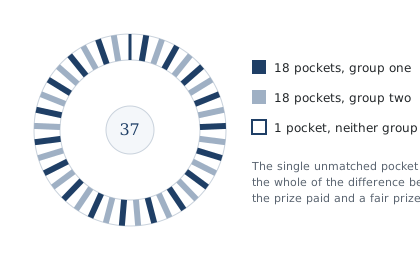
A single number on thirty-seven pockets
occurs once in 37   ->  break-even prize = 36 to 1
prize actually paid                     = 35 to 1
shortfall                               =  1 unit

  win   1/37  x  (+35)  =  +0.945946
  lose 36/37  x  ( -1)  =  -0.972973
                          -----------
  expected value        =  -0.027027   per unit staked

  = -1/37 = -2.70 %
The same wheel, a different bet
An even-money bet covers eighteen pockets and pays 1 to 1, where the break-even prize for a result occurring eighteen times in thirty-seven would be 19 to 18. The arithmetic looks different and the answer does not change, because the single pocket outside both groups is the whole of the shortfall either way.
  win  18/37  x  (+1)  =  +0.486486
  lose 19/37  x  (-1)  =  -0.513514
                         -----------
  expected value       =  -0.027027   per unit staked  =  -2.70 %
This is the first structural point. On a wheel of this design every bet carries the same edge, because every prize schedule on it is built by treating the unmatched pocket as though it did not exist. Choosing between bets on such a wheel changes the shape of the distribution and leaves its centre exactly where it was.
Adding one more unmatched pocket
Single number, 38 pockets, still paid 35 to 1

  win   1/38  x  (+35)  =  +0.921053
  lose 37/38  x  ( -1)  =  -0.973684
                          -----------
  expected value        =  -0.052632   per unit staked

  = -2/38 = -1/19 = -5.26 %
One extra pocket, no change to any prize, and the expected retention very nearly doubles. The prizes are identical on both wheels, which is why prizes alone never establish an edge: the prize is one half of the comparison and the count of ways to lose is the other.
A multi-stage bet
Not every game settles in one trial. A common dice sequence resolves at once on the first roll if the total is 7 or 11 (a win) or 2, 3 or 12 (a loss); otherwise the total rolled becomes a target, and the sequence continues until either that target or a 7 appears. Once a target t is set, only the rolls producing t or 7 matter, so the probability of reaching the target is the count of ways to make t divided by the count of ways to make t or 7.
target   ways(t)   ways(7)   P(make it)        P(set it)
  4        3         6       3/9  = 0.3333     3/36
  5        4         6       4/10 = 0.4000     4/36
  6        5         6       5/11 = 0.4545     5/36
  8        5         6       5/11 = 0.4545     5/36
  9        4         6       4/10 = 0.4000     4/36
 10        3         6       3/9  = 0.3333     3/36

P(win) = P(7 or 11 at once) + sum over targets of P(set) x P(make)

       = 8/36
       + 2 x [ (3/36)(3/9) + (4/36)(4/10) + (5/36)(5/11) ]
       = 0.222222
       + 2 x [ 0.027778 + 0.044444 + 0.063131 ]
       = 0.222222 + 0.270707
       = 0.492929        (= 244/495)

expected value = (2 x 0.492929) - 1
               = -0.014141    per unit staked  =  -1.41 %
An edge of 1.41 % is among the smaller ones found in commercial games, and it is still an edge. The point of working it out in full is that its size is not a matter of opinion or of how the game feels to play; it falls out of the count of ways to make each total, and nothing in the sequence of play can move it.
Why the edge is structural
Three properties follow directly from the arithmetic above, and they hold for every game built this way. The edge is fixed in the rules before play, so it is not a result that a session can come out on the wrong side of. It applies per unit staked, so a unit won back and staked again is charged again, and total expected loss tracks turnover rather than starting funds. And it is unaffected by the order or timing of trials, because independent trials have no mechanism by which order could matter. The consequence is a plain arithmetic one: sustained play against a fixed negative edge loses money in proportion to the amount staked, and no staking pattern alters that sum.